
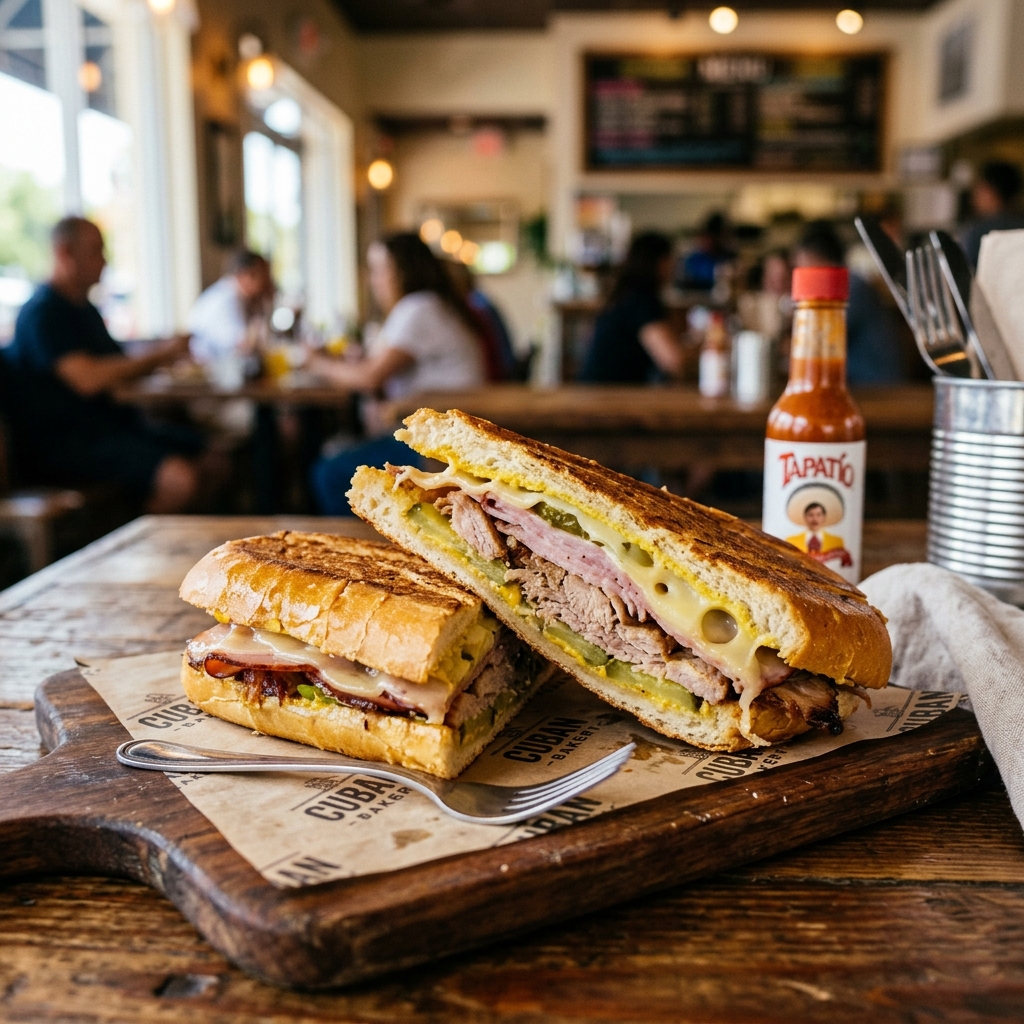
Classic Miami Cuban Sandwich
Disclosure: Top Local Diner is reader-supported. When you buy through links on our site, we may earn an affiliate commission. Learn more.
The Cuban sandwich, affectionately known as the Cubano, is much more than a simple ham and cheese press—it is a tangible piece of Florida's rich cultural history. Born out of necessity in the late 19th and early 20th centuries, it was originally created as a hearty, portable lunch for the thousands of Cuban immigrant workers employed in the thriving cigar factories of Key West and Ybor City, Tampa.
However, it was in Miami where the Cubano truly evolved into an international culinary icon. The secret to a phenomenal Miami-style Cuban sandwich lies entirely in its architecture and the quality of its components. It is a masterclass in contrasting flavors and textures: the savory depth of slow-roasted, citrus-marinated mojo pork perfectly balances the subtle sweetness of sliced ham, while the sharp, acidic tang of yellow mustard and dill pickles cuts right through the richness of the melted Swiss cheese.
Equally important is the bread itself. Authentic Cuban bread is baked with lard, which gives it a uniquely crispy, papery crust and an incredibly soft, airy interior. When placed into a hot plancha (sandwich press), the bread flattens dramatically, toasting the exterior to a golden crunch while fusing the layers of meat and cheese inside into a single, cohesive masterpiece of comfort food.
Ingredients
- 1 large loaf of authentic Cuban bread (or a soft French/Italian baguette if unavailable)
- 4 oz thinly sliced sweet ham (Virginia or Bolo ham preferred)
- 4 oz traditional slow-roasted mojo pork, thinly sliced
- 4 slices high-quality Swiss cheese
- 4 large dill pickles, thinly sliced lengthwise
- 2-3 tablespoons classic yellow mustard (do not substitute with Dijon)
- 2 tablespoons unsalted butter, softened
- Optional: a thin layer of mayonnaise (controversial, but accepted in some Tampa variations)
Instructions
Begin by slicing the Cuban bread horizontally down the middle to create a top and bottom half. Ensure the bread is fresh but sturdy enough to hold the ingredients.
Generously spread the softened butter on the outside crust of both the top and bottom halves of the bread. This will ensure a beautiful, golden-brown crust when pressed.
Spread the classic yellow mustard evenly over the inside of both the top and bottom halves of the bread. The acidity of the mustard is crucial to cutting through the rich meats.
Begin assembling the sandwich by layering the ingredients in this specific order to ensure structural integrity and proper melting: start with the slices of Swiss cheese on the bottom half.
Next, neatly fold and layer the thinly sliced sweet ham over the cheese.
Follow the ham with an even layer of the sliced, roasted mojo pork. If the pork is cold, quickly searing it in a pan for 30 seconds can elevate the flavor.
Top the pork with the thinly sliced dill pickles, arranging them so that every bite of the sandwich will contain a bit of pickle crunch.
Place the top half of the bread over the pickles to close the sandwich.
Preheat a plancha, panini press, or a large cast-iron skillet over medium-high heat. If using a skillet, you will need a second heavy skillet or a foil-wrapped brick to act as a weight.
Place the assembled sandwich onto the hot surface. If using a skillet, place the heavy weight on top to firmly compress the sandwich. Cook for 4 to 5 minutes until the bottom crust is deeply golden and crispy.
Carefully flip the compressed sandwich, reapply the weight, and cook for an additional 4 to 5 minutes until the cheese is completely melted and bubbling at the edges.
Remove from the heat, let it rest for 1 minute so the cheese sets slightly, then slice diagonally and serve immediately.
Chef's Pro Tips
The Golden Rule of Mustard
Never, under any circumstances, substitute the standard yellow mustard with Dijon, spicy brown, or stone-ground mustard. The specific bright, sharp, vinegary tang of cheap yellow mustard is historically accurate and essential to the authentic Cubano flavor profile.
Mastering the Press
A true Cuban sandwich must be aggressively flattened. If you don't own a heavy panini press, wrap a heavy brick or a cast-iron skillet in aluminum foil and press down firmly on the sandwich while it cooks. The goal is to compress it to about one-third of its original height.
The Salami Debate
If you are aiming for a 'Tampa-style' Cuban rather than a Miami-style, add a layer of thinly sliced Genoa salami between the ham and the pork. This was introduced by the Italian immigrants who lived alongside the Cubans in Ybor City.