
Classic New England Clam Chowder
Disclosure: Top Local Diner is reader-supported. When you buy through links on our site, we may earn an affiliate commission. Learn more.
To truly understand the culinary soul of Massachusetts, one must look no further than a steaming bowl of New England clam chowder. Introduced by French, Nova Scotian, and British settlers in the 18th century, this hearty soup quickly became a staple along the rugged Atlantic coast. It was a dish born of the sea, designed to provide immense warmth and dense caloric energy to sailors and fishermen returning from long, freezing voyages.
Unlike its tomato-based cousin from Manhattan, an authentic New England clam chowder is defined by its incredibly rich, dairy-based broth. But the secret to a historically accurate chowder doesn't actually begin with dairy—it begins with rendered salt pork or thick-cut bacon. The smoky, savory fat serves as the foundation for the entire dish, providing a depth of flavor that cannot be replicated with butter alone. The soup is then thickened with a simple roux, creating a velvety texture that clings to the spoon.
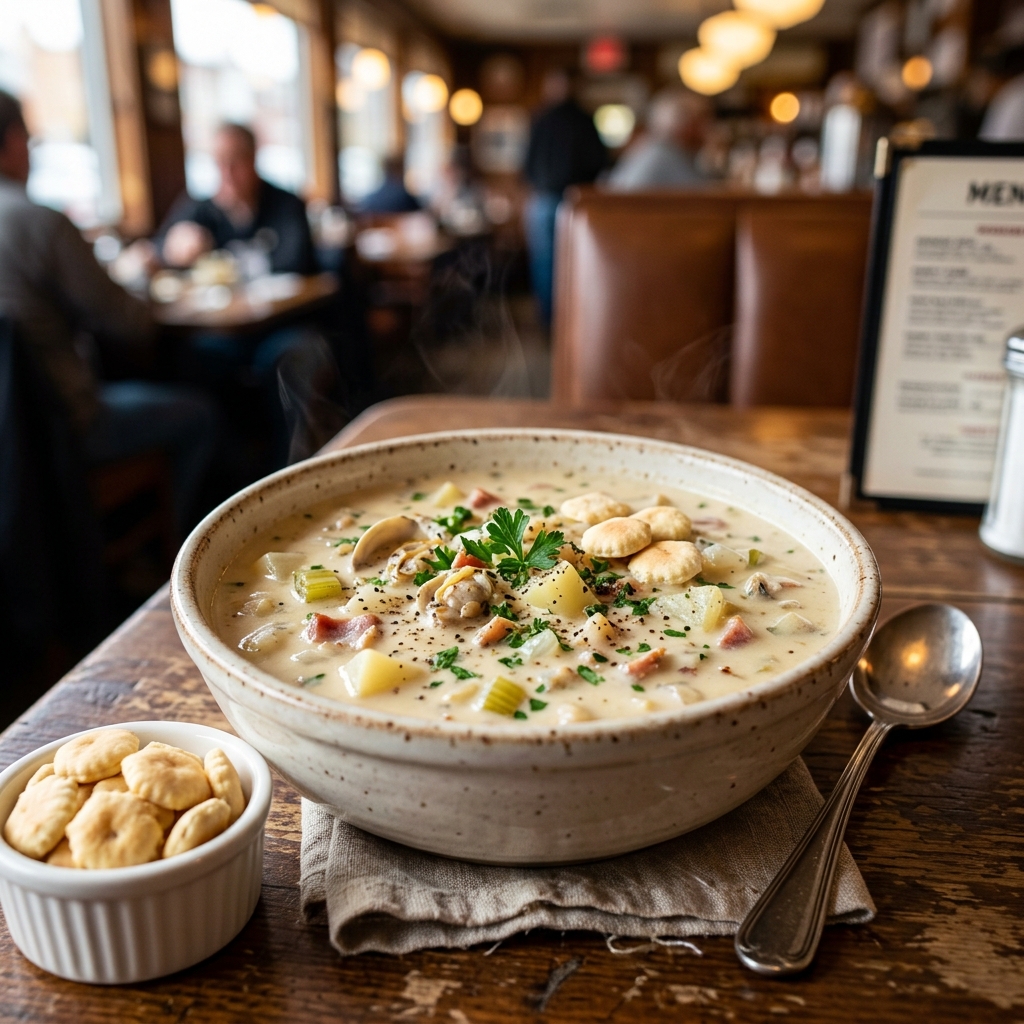
The real stars of the dish, however, are the fresh quahogs (hard-shell clams) and the starchy potatoes. The clams provide a sweet, briny taste of the ocean, while the potatoes naturally thicken the broth as they simmer and break down. Served with a handful of traditional oyster crackers, this iconic chowder remains a timeless testament to New England's enduring maritime heritage.
Ingredients
- 4 lbs fresh cherrystone or quahog clams, scrubbed clean (or 3 cans chopped clams in juice)
- 4 oz salt pork or thick-cut smoked bacon, finely diced
- 2 tablespoons unsalted butter
- 1 large yellow onion, finely diced
- 2 stalks celery, finely diced
- 3 tablespoons all-purpose flour
- 1 1/2 lbs Russet potatoes, peeled and cut into 1/2-inch cubes
- 2 cups clam broth or seafood stock (reserved from steaming the clams)
- 1 cup heavy cream
- 1 cup whole milk
- 2 bay leaves
- 1/2 teaspoon fresh thyme leaves
- Salt and heavily cracked black pepper to taste
- Oyster crackers and fresh parsley for garnish
Instructions
If using fresh clams: place the scrubbed clams in a large pot with 2 cups of water. Cover tightly and steam over medium-high heat for 8 to 10 minutes until all the shells have opened. Discard any clams that remain closed. Remove the clam meat from the shells, chop roughly, and set aside. Strain the remaining liquid through a fine-mesh sieve or coffee filter to remove grit, and reserve this liquid as your clam broth.
In a heavy-bottomed Dutch oven or large soup pot, render the diced salt pork or bacon over medium-low heat. Cook slowly for about 8 to 10 minutes until the fat has completely melted out and the pork bits are crispy and golden brown. Use a slotted spoon to remove the crispy bits and set them aside for garnishing later.
Add the unsalted butter to the rendered pork fat in the pot. Once melted, add the diced onions and celery. Sauté over medium heat for about 5 to 7 minutes, stirring occasionally, until the vegetables are very soft and translucent, but not browned.
Sprinkle the all-purpose flour over the softened vegetables. Stir constantly for 2 to 3 minutes. This cooks the raw flavor out of the flour and creates a roux, which will thicken the chowder.
Slowly whisk in the reserved clam broth, ensuring there are no flour lumps. Add the diced potatoes, bay leaves, and fresh thyme. Bring the mixture to a gentle simmer.
Cover the pot and simmer gently for 15 to 20 minutes, or until the potatoes are fork-tender. Some of the potatoes will naturally begin to break down, which further thickens the broth.
Stir in the chopped clams, heavy cream, and whole milk. Return to a very low simmer and cook for an additional 5 minutes until everything is heated through. Do not let the soup boil rapidly, or the cream may curdle and the clams will become rubbery.
Remove the pot from the heat and discard the bay leaves. Taste the chowder and season with salt (if needed, as clams are naturally salty) and a very generous amount of freshly cracked black pepper.
Ladle the hot chowder into deep bowls. Garnish with the reserved crispy pork bits, fresh parsley, and a handful of classic oyster crackers.
Chef's Pro Tips
Do Not Overcook the Clams
Clams become incredibly tough and rubbery if exposed to high heat for too long. Always add them at the very end of the cooking process, just long enough to warm them through.
The Importance of Russet Potatoes
Avoid using waxy potatoes like red or Yukon Gold. The high starch content in Russet potatoes allows their edges to naturally break down and melt into the broth as they simmer, creating the authentic, thick New England texture.
Always Strain the Broth
Fresh clams often hold sand and grit. Always strain your reserved clam cooking liquid through a fine-mesh sieve lined with a coffee filter or cheesecloth to ensure your chowder is perfectly smooth.