
Authentic Texas Smoked Brisket
Disclosure: Top Local Diner is reader-supported. When you buy through links on our site, we may earn an affiliate commission. Learn more.
In the sprawling expanse of the Lone Star State, barbecue is not merely a method of cooking; it is a deeply revered religion. And within that religion, the Central Texas smoked brisket is the undisputed holy grail. Historically, the brisket is an incredibly tough, unforgiving cut of meat located in the lower chest of the cow, burdened with massive amounts of dense connective tissue. Early German and Czech immigrants who settled in Texas meat markets realized that by cooking this cheap cut slowly over indirect wood smoke for a painstakingly long time, those tough tissues would magically melt away into liquid gelatin.
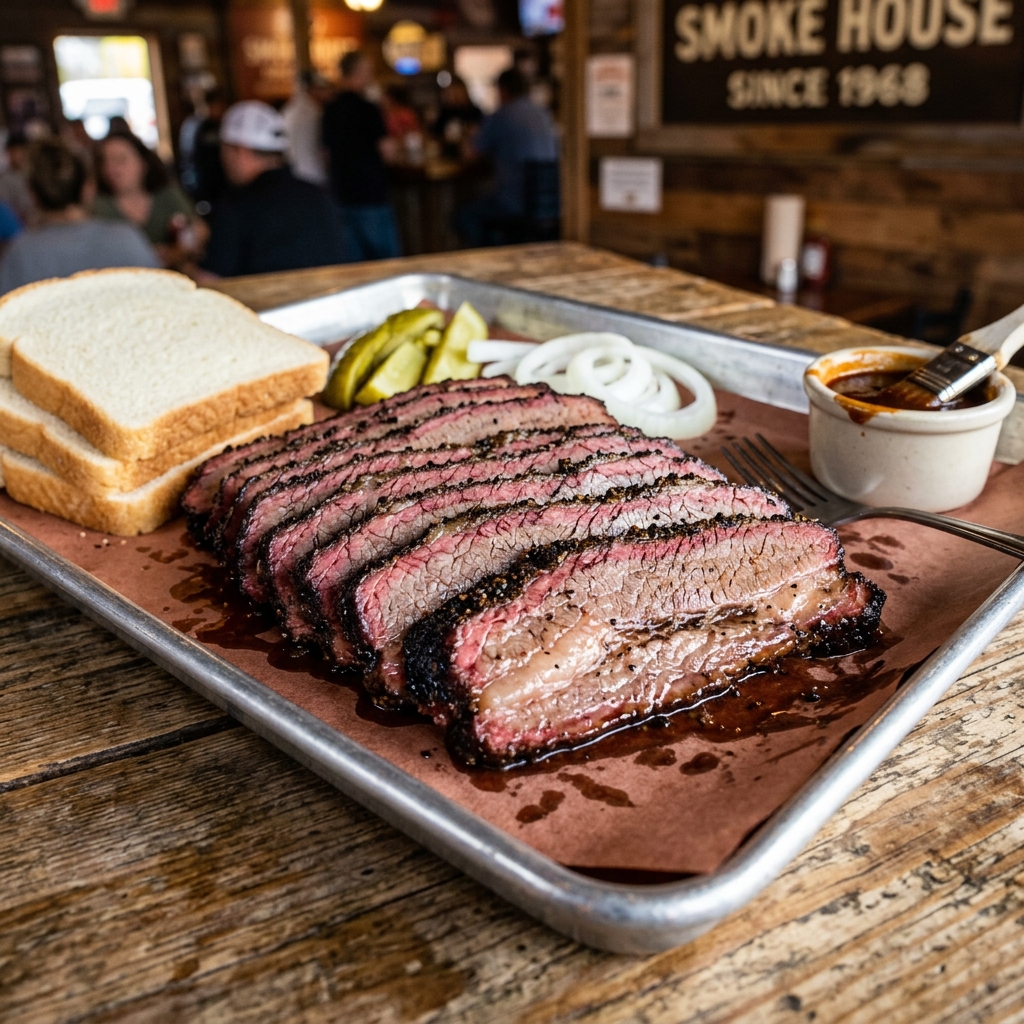
True Central Texas barbecue is defined by its austere, unapologetic simplicity. There are no sweet, sticky sauces to hide behind, and no complicated marinades. The entire flavor profile relies exclusively on three things: the quality of the beef, a brutally simple rub of equal parts coarse salt and cracked black pepper, and the clean, steady smoke of post oak wood. The magic happens during the arduous 12-to-16-hour smoking process, where the pepper rub interacts with the smoke and rendering fat to create the 'bark'—a thick, dark, meteor-like crust that seals in the staggering amount of moisture.
When a perfectly smoked brisket is finally sliced, it should possess a distinct 'smoke ring' (a vibrant pink halo just beneath the bark), and the meat should be so impossibly tender that a slice draped over your finger droops without breaking, yet easily pulls apart with the slightest tug. Achieving this requires immense patience, meticulous fire management, and a deep respect for the craft.
Ingredients
- 1 whole packer brisket, untrimmed (12 to 14 lbs) - ensure it includes both the 'flat' and the fattier 'point' muscles
- 1/2 cup coarse kosher salt
- 1/2 cup freshly cracked, 16-mesh coarse black pepper
- Optional: 1 tablespoon garlic powder (controversial to purists, but delicious)
- Yellow mustard or hot sauce (used solely as a binder for the rub)
- Unwaxed butcher paper (for wrapping)
- Post Oak or Hickory wood chunks/splits for smoking
Instructions
Begin with the most critical step: trimming. Place the cold brisket fat-side down. Remove the thick, hard crescent of fat (the deckle) between the flat and the point, as it will never render. Flip the brisket over to the fat cap side. Trim the fat cap down to an even 1/4-inch thickness across the entire top. Aerodynamic trimming prevents the edges from burning.
In a shaker, vigorously mix the coarse kosher salt, coarse black pepper, and garlic powder to create the traditional 'Dalmatian rub'.
Apply a very thin, light coating of yellow mustard or hot sauce all over the brisket. This acts as a binder; you will not taste it after the 12-hour smoke.
Generously and evenly coat the entire brisket with the salt and pepper rub. Pat the rub firmly into the meat—do not rub it in, as that will cause clumping. Let the seasoned brisket rest at room temperature for 1 hour while you prepare the smoker.
Prepare your offset smoker or pellet grill to maintain a perfectly steady temperature of 250°F (120°C) to 275°F (135°C). Use Post Oak wood for the most authentic Central Texas flavor.
Place the brisket on the smoker grates, fat-side up (or towards the heat source, depending on your smoker). Close the lid and do not open it for the first 3 hours. Maintaining clean, almost invisible 'blue smoke' is crucial.
After 3 hours, begin spritzing the edges of the brisket every hour with a mixture of water and apple cider vinegar only if they appear to be drying out or burning.
Around the 5 to 7-hour mark, the internal temperature of the meat will hit roughly 165°F (74°C). The meat will 'stall', and the bark will have formed a dark, mahogany crust. This is the time to wrap.
Remove the brisket and tightly wrap it in two layers of unwaxed, unlined butcher paper. This technique (the 'Texas Crutch') pushes the meat through the stall while preserving the crispy bark, unlike foil which steams and ruins the crust.
Return the wrapped brisket to the smoker. Continue cooking until the internal temperature at the thickest part of the flat reads between 200°F (93°C) and 205°F (96°C). More importantly, the temperature probe should slide into the meat with zero resistance, like inserting a hot knife into room-temperature butter.
Remove the brisket from the smoker. This next step is mandatory: leave it wrapped in the butcher paper and place it inside a dry, insulated cooler (without ice). Close the lid and let the brisket rest for an absolute minimum of 2 hours, up to 4 hours. This monumental resting period allows the violently boiling juices to settle and redistribute.
To serve, unwrap the brisket and place it on a large cutting board. Cut the brisket in half to separate the lean 'flat' from the fatty 'point'. Slice the flat against the grain in pencil-thick slices. Turn the point 90 degrees and slice it against the grain as well.
Chef's Pro Tips
Respect the Rest
A 12-hour smoke is utterly ruined if you slice the meat immediately. Resting the brisket in an insulated cooler for 2-4 hours is arguably as important as the smoking process itself, guaranteeing the juices reabsorb into the meat.
Butcher Paper vs. Foil
Always wrap your brisket in unwaxed pink butcher paper. Aluminum foil traps steam and turns your beautiful, crispy bark into a soggy, pot-roast-like mush. Butcher paper is breathable, retaining moisture while protecting the crust.
The 16-Mesh Pepper Rule
Standard table pepper is far too fine and will result in an overly spicy, dusty crust. You must use 16-mesh coarse cracked black pepper to achieve that dark, craggy, authentic Texas bark without overwhelming the beef flavor.